According to WHO estimates released in 2023, the road traffic fatality rates per 100,000 population and the estimated number of deaths for Southeast Asian countries in 2021 are shown in the table below. (Brunei has been excluded due to data inaccuracies, and figures for Japan are included for reference.) Among the nine Southeast Asian nations, Thailand has the highest fatality rate, highlighting the severity of road traffic accidents in the country. Furthermore, fatality rates across Southeast Asian countries are generally high, suggesting that traffic accidents remain a critical challenge for each nation.

Data from the Thailand Road Safety Collaboration show that the accident rate involving trucks per 10,000 registered vehicles fluctuated significantly between 2012 and 2022. The rate peaked at 48.23 cases in 2018, then declined to 30.04 cases in 2022. These fluctuations highlight that road safety is influenced by multiple factors, including driver behavior, road conditions, traffic density, and environmental differences across provinces.
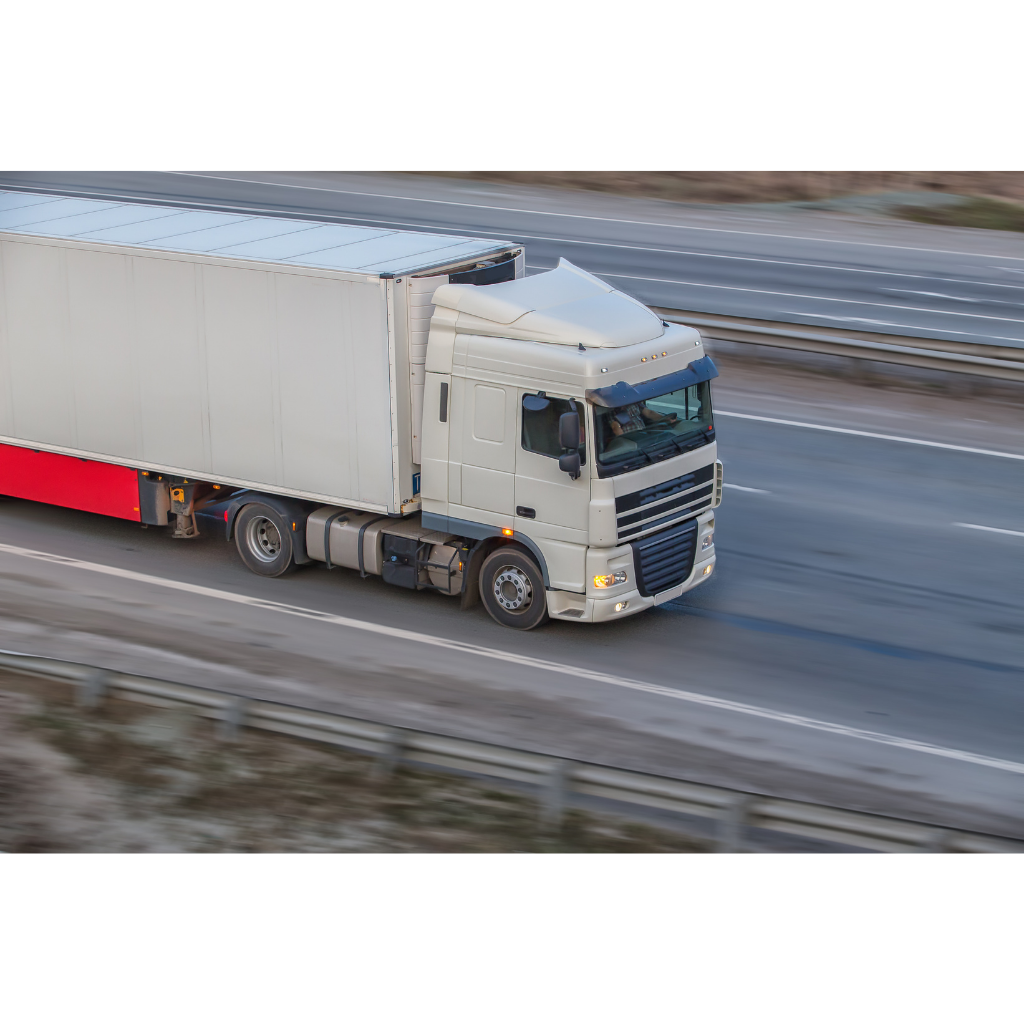
One critical yet often overlooked factor that plays a major role in accidents is TRUCK BLIND SPOTS, which are areas not visible to the driver and can become the starting point of risks that may lead to severe accidents without warning.
For example, in 2025 in Chachoengsao Province, a ten-wheel truck crashed into multiple vehicles stopped at a red light in front of a school, injuring several students and parents. The driver was unable to slow down in time due to extended braking distance and limited visibility at close range. Similarly, in urban areas, motorcycles attempting to pass on the left side of a turning truck often collide with it because they are in the driver’s blind spot. In both cases, the root cause is the same: drivers cannot see each other.
What are truck blind spots?

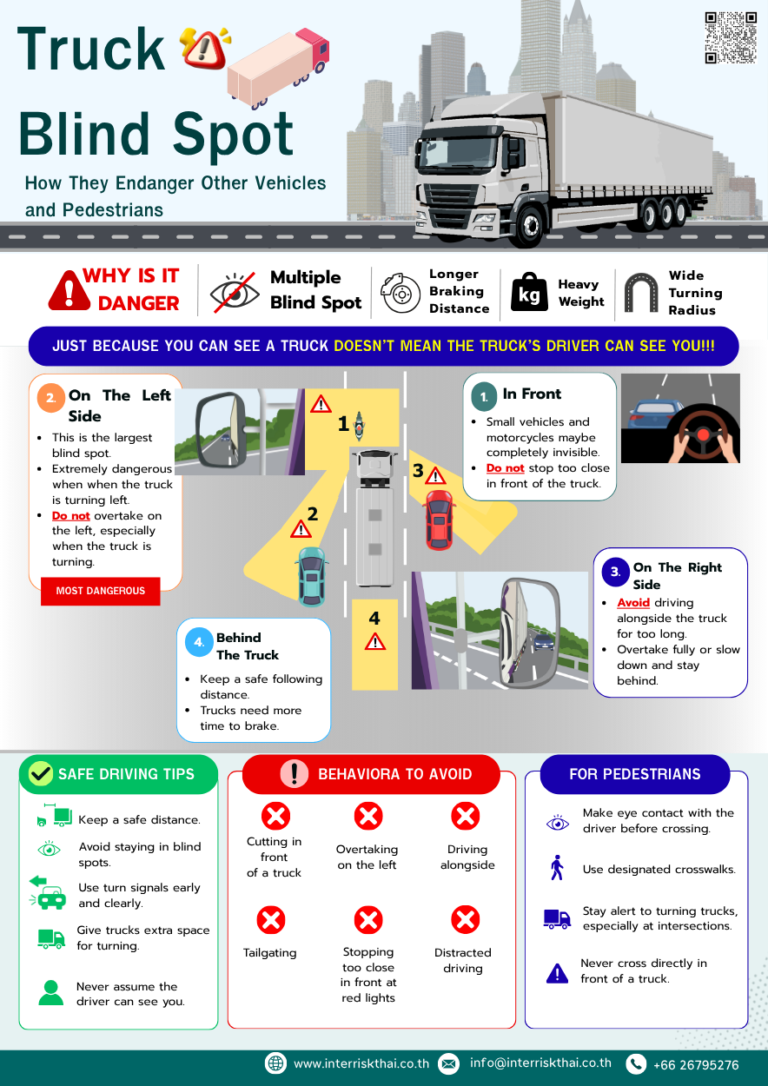
Truck blind spots are areas surrounding the vehicle that cannot be seen by the driver through mirrors, whether in front, on the left, on the right, or at the rear. Due to their large size and limited field of vision, trucks have several areas that fall outside the driver’s line of sight. If another vehicle or a pedestrian is in these areas, the driver may be completely unaware of their presence.
Accidents involving trucks are often more severe than usual due to their weight and impact force. In many cases, blind spots are the factor that turns a minor situation into a much more serious accident. Truck blind spots consist of four main areas, as follows:
1. In front of the truck
The driver’s seat in a truck is positioned at a higher level, which can make it difficult to see objects that are very close to the front of the vehicle.


Risks
- Forward Blind Spot
Small vehicles and motorcycles positioned directly in front of a truck may be hidden in its front blind spot. - Braking Distance
Due to the longer braking distance characteristic of trucks (the distance traveled from the moment the brakes begin to take effect until the vehicle comes to a complete stop), even if the driver notices a vehicle ahead, the truck may not be able to stop in time.
Behaviors to avoid
- Cutting in front of a truck at close range
- Stopping too close in front of a truck at a red light
- Merging in front of a truck and braking suddenly
Recommended actions
- Maintain enough distance so the truck driver can see your entire vehicle in the mirrors
- After overtaking, allow sufficient space before returning to the lane
2. On the right side of the truck
If it is necessary to drive in the lane on the right side of a truck, avoid staying in the area from the side mirror extending to the truck door, as drivers often have limited visibility in this zone.


Risks
- Right-Side Blind Spot
Small vehicles or motorcycles driving alongside a truck enter its right-side blind spot. - Side collision
When a truck attempts to change lanes to the right, the driver may fail to notice a vehicle running parallel to them, resulting in a collision from the right side.
Behaviors to avoid
- Driving alongside the truck door
- Staying parallel with the truck for an extended period
- Hesitating while overtaking and remaining too long in the blind spot
- Assuming that the truck driver can see you
Recommended actions
- Avoid staying in blind spots
- Slow down and move behind the truck
3. On the left side of the truck
This is a highly dangerous area because the driver has less visibility compared to the right side, as it is farther from the driver’s position.


Risks
- Left-Side Blind Spot
Small vehicles or motorcycles traveling alongside a truck enter its left-side blind spot. The left side is frequently where a truck’s largest blind spot is located. - Side Collision
When a truck attempts to change lanes to the left, the driver may fail to notice a vehicle running parallel to them, resulting in a collision from the left side. - Left-Turn Collision
When a truck makes a left turn, the driver may fail to notice a motorcycle traveling alongside them, trapping or sweeping it under the left side of the vehicle.
Behaviors to avoid
- Passing on the left, especially when the truck is slowing down or turning
- Driving alongside the truck on the left side
- Assuming that the truck driver can see you
Recommended actions
- Keep as far away as possible from the left side
- If the truck signals a turn, do not overtake under any circumstances
- Allow sufficient space for the truck to make a wide turn
4. Behind the truck
In some cases, truck drivers can barely see vehicles directly behind them. If the truck is containing a product at the rear, visibility may be completely obstructed.

Risks
Blind Spot
Visibility directly behind a truck is extremely limited.Rear Collision
Tailgating leaves insufficient time to react when a truck brakes, resulting in a rear collision.Left-Turn Collision
When a truck makes a left turn, the driver may fail to notice a motorcycle traveling alongside them, trapping it under the left side of the vehicle.
Behaviors to avoid
- Tailgating
- Using a phone or losing focus while driving behind a truck
- Assuming that trucks can brake as quickly as cars
Recommended actions
- Maintain a sufficient distance between the truck and your vehicle.
- Be prepared for the truck to brake suddenly, and be ready to brake at any time.
Example of accidents caused by truck blind spots
1. Motorcyclist Killed in Phuket After Stopping in Truck’s Blind Spot

A tragic accident occurred at a signalized intersection in Phuket when a ten-wheel truck was waiting in a right turn lane at a red light. A 54-year-old woman on a motorcycle moved ahead and stopped directly in front of the truck, intending to turn right as well. When the light changed, the truck moved forward at the wrong moment and struck the motorcycle. The front left wheel then ran over the rider, who later died from her injuries. CCTV footage confirmed that the driver did not see the motorcycle because it was in the truck’s front blind spot. Due to the height and design of large trucks, objects that are close to the front, especially small vehicles, can be completely invisible to the driver. This creates a serious danger when motorcyclists stop too close to the truck.
To reduce this risk, riders should avoid stopping directly in front of large trucks and instead position themselves where they can be seen while keeping a safe distance. At the same time, truck drivers should carefully check their surroundings before moving, use mirrors and visibility aids effectively, and avoid accelerating immediately when the light changes.
2. Three Injured in Bangkok After Truck Driver Loses Focus on Road

Another accident in Bangkok involved a six-wheel truck crashing into a pickup truck and a police checkpoint, injuring three people. The driver admitted that he looked down to pick up his mobile phone, and because another vehicle was blocking his view, he failed to notice the checkpoint ahead. Although no alcohol was found in his system, the incident highlights a behavioral blind spot, where distraction causes a driver to lose awareness of the road. Even a brief moment of inattention can prevent a driver from seeing hazards, especially when operating a large truck with a heavy weight and a longer stopping distance. This makes any mistake more severe and harder to correct.
To prevent such accidents, drivers must avoid using mobile phones while driving and keep their full attention on the road at all times. In addition, maintaining a safe following distance and anticipating potential hazards, especially in high-risk areas, are essential steps to reduce the chances of serious collisions.
Safety Checklists for Road Users Near Trucks
Sharing the road with trucks requires awareness and cooperation from all road users. Due to their size, weight, and limited visibility, trucks present unique risks that must be understood and respected. The following checklists outline recommended practices for car drivers, motorcycle riders, and pedestrians when operating or moving near trucks.
Road safety is determined not by whether you can see a truck, but by whether the truck driver can see you. For drivers, riders, and pedestrians alike, understanding the limits of truck visibility and adjusting behavior accordingly can prevent serious accidents. Small actions such as allowing extra space, avoiding blind spots, and making movements predictable can have a substantial impact on safety.
1. Checklist for Car Drivers
Recommended Practices
- Maintain a greater following distance from trucks than from passenger vehicles.
- Ensure that overtaking is completed fully before returning to the lane in front of a truck.
- Observe truck turn signals and vehicle movement well in advance.
- Use turn signals clearly and consistently when changing lanes or overtaking.
- Allow sufficient space for trucks when they need to turn or change lanes.
Practices to Avoid
- Driving alongside a truck for extended periods.
- Cutting in front of a truck at close range.
- Remaining in areas where the truck driver may have limited or no visibility.
- Assuming that the truck driver can see your vehicle at all times.
2. Checklist for Motorcycle Riders
Recommended Practices
- Position your motorcycle where it is clearly visible to the truck driver.
- Maintain a greater-than-normal distance from trucks, especially near the wheels.
- Reduce speed and increase vigilance when a truck signals a turn.
- Exercise extra caution at intersections and in congested traffic.
Practices to Avoid
- Overtaking trucks on the left side under any circumstances.
- Riding through narrow gaps or spaces that appear passable but limit visibility.
- Traveling alongside trucks for prolonged periods.
- Stopping or waiting in blind spot areas, particularly at traffic signals.
3. Checklist for Pedestrians
Recommended Practices
- Wait for trucks to pass completely if visibility or safety is uncertain.
- Use designated pedestrian crossings whenever possible.
- Make eye contact with the truck driver before crossing in front of the vehicle.
- Remain alert to trucks that are turning, especially at intersections.
Practices to Avoid
- Crossing directly in front of a truck at close distance.
- Standing near the front, sides, or wheels of a truck.
- Assuming that the truck driver has noticed your presence.
- Expecting trucks to stop as quickly as smaller vehicles.
Summary
Trucks play a vital role in Thailand’s transportation system, particularly on major routes connecting cities and economic areas. However, due to their large size, heavy weight, long braking distance, and limited visibility, trucks are more difficult to control and are associated with more severe accidents. One key risk factor is truck blind spots, which are areas around the vehicle that drivers cannot see, making it possible for other road users to be present without the driver’s awareness.
Blind-spot-related accidents often occur when vehicles or motorcycles drive too closely, remain alongside trucks, or change lanes without proper observation. These risks are further increased in dense traffic, poor road conditions, or when drivers misjudge speed and distance.
Improving road safety requires understanding the limitations of trucks from multiple perspectives, including truck drivers, car drivers, motorcyclists, and pedestrians. Safe practices include maintaining sufficient distance, avoiding blind spot areas, using signals clearly, and making predictable driving decisions.
Ultimately, road safety depends not only on following traffic rules but also on recognizing that other road users may not always be able to see us. Small adjustments in behavior, such as allowing more space and choosing safer moments to move, can significantly reduce both the likelihood and severity of accidents.
Reference
- https://www.frontiersin.org/journals/built-environment/articles/10.3389/fbuil.2025.1684955/full
- https://www.who.int/thailand/our-work/road-safety
- https://www.bangkokpost.com/thailand/general/3077576/truck-hits-vehicles-stopped-at-red-light-students-injured
- https://www.khonraksiplo.com/content/29628/
- https://www.trumqtaxi.com/drive-near-truck
- https://www.sanook.com/news/7860187/
- https://www.khaosod.co.th/breaking-news/news_9688420#google_vignette